Walk into a serious fine dining restaurant for the first time and you'll notice something almost theatrical about it. The table is set with more silverware than seems strictly necessary. A server places your napkin on your lap. The menu reads like a short story, with ingredients listed by their farm of origin. Someone appears to refill your water glass before you realized it was low. None of this is accidental — every detail is the product of more than a century of deliberate construction. Understanding where these rituals came from changes how you experience them, and makes the whole thing considerably less intimidating.
The Blueprint: How Modern Fine Dining Was Built
The story of fine dining as we recognize it begins in post-revolutionary France. Before the late 18th century, elaborate cooking was the exclusive domain of aristocratic households. When the French Revolution dismantled those households, their trained cooks needed somewhere to work. The restaurant — a public space where individual diners could order from a written menu and pay for individual meals — became their stage.
The decisive figure in shaping what that stage looked like was Auguste Escoffier, who worked primarily in the late 19th and early 20th centuries. Escoffier codified the brigade de cuisine — the hierarchical kitchen system that divides labor into specialized stations, each with a defined role. The saucier handles sauces, the poissonnier fish, the garde manger cold preparations, and so on, all coordinated by an executive chef. This wasn't just organizational tidiness; it was a method for producing consistent, high-quality food at scale, night after night. The brigade system is still the operational backbone of virtually every serious restaurant kitchen in the world.

As an Amazon Associate, I earn from qualifying purchases.
Escoffier also partnered with hotelier César Ritz, and together they established the culinary origins of the grand hotel dining room as a social institution — a place where the middle and upper classes could perform refinement in public. The dining room became as carefully managed as the kitchen.
Mise en Place: The Philosophy Behind the Preparation
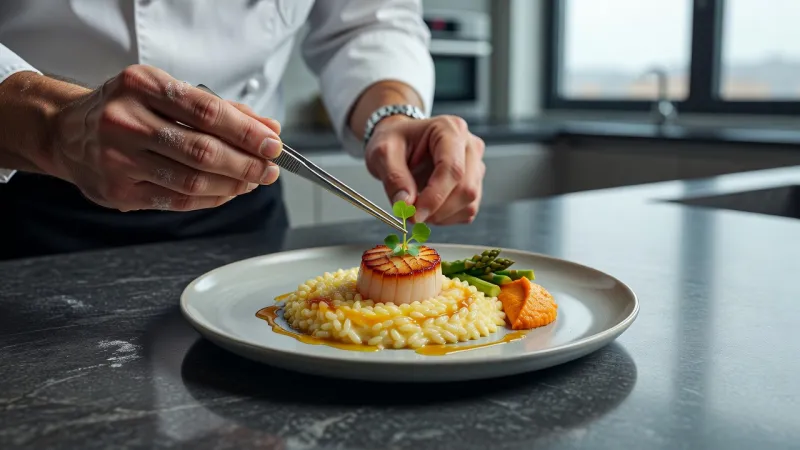
Before a single diner arrives, the fine dining kitchen has been in motion for hours. The French phrase mise en place — literally "everything in its place" — describes both a physical practice and a philosophy. Stocks are made, vegetables are cut to precise dimensions, sauces are reduced and held at temperature, garnishes are arranged. Every component that can be prepared in advance is prepared in advance, so that service becomes a matter of assembly and finishing rather than starting from zero.
For the diner, mise en place is invisible, which is exactly the point. The reason a dish arrives quickly, with its components perfectly integrated, is because most of the work was done before you sat down. The apparent effortlessness of fine dining service is an illusion produced by meticulous backstage preparation — and recognizing that changes how you read a menu price.
The Language of the Menu
A fine dining menu communicates in a specific dialect, and learning a few of its conventions makes the experience more navigable. The most important structural concept is the tasting menu or menu dégustation — a fixed sequence of small courses designed by the chef to tell a coherent story. Rather than choosing individual dishes, you surrender the decision to the kitchen. This format became popular because it allows a chef to control the arc of a meal: building from delicate to intense, balancing richness with acidity, moving through a logical progression of seasons and techniques.
As an Amazon Associate, we earn from qualifying purchases.
À la carte menus, by contrast, let you compose your own meal from individual dishes. Fine dining à la carte menus are typically short — sometimes dramatically so. A menu with six appetizers and six mains is a signal that everything on it is made with precision, sourced carefully, and rotated with the season. A long menu is often a warning sign in this context.
The ingredient sourcing language you'll find on fine dining menus — the named farms, the specific regions, the heritage breed animals — reflects a shift that accelerated in the 1990s and early 2000s, when chefs increasingly built their identities around provenance as much as technique. When a menu says "dry-aged grass-fed beef from a named ranch," it's making a claim about the chef's supply chain and their values, not just the flavor of the steak.
The Brigade in the Dining Room
The kitchen has its brigade; the dining room has its own parallel hierarchy. The maître d'hôtel (or maître d') manages the floor, coordinating the sequence of service, handling special requests, and reading the room's temperature — literally and socially. Captains oversee sections of tables. Servers take orders and communicate with the kitchen. Sommeliers manage the wine program. Runners carry plates. Each role has a defined function, and in a well-run fine dining room, they operate without apparent friction.
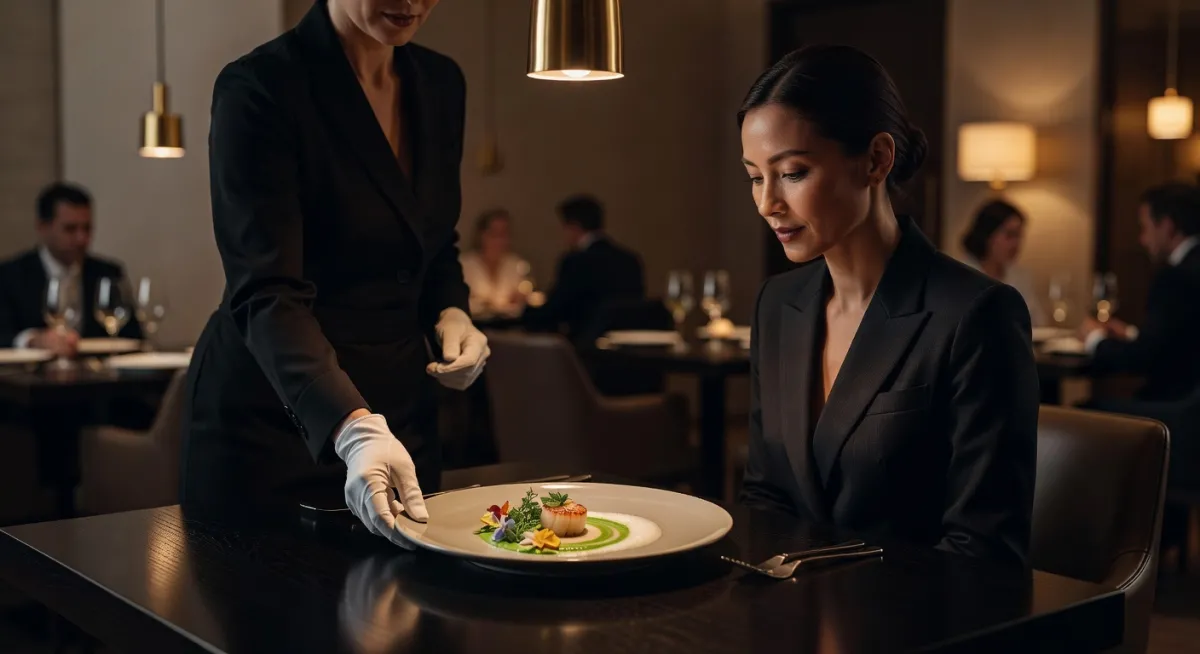
Tableside service — the finishing of a dish in front of the guest — is one of the most visually distinctive elements of the format. Whether it's a sauce poured from a small pitcher, a pasta tossed in a wheel of aged cheese, or a dessert finished with a flame, tableside work serves multiple purposes. It adds a sensory experience — you smell the sauce before you taste it, you see the technique. It also creates a moment of connection between the kitchen's craft and the person eating. And practically, it means the dish can be finished at exactly the right moment, rather than plated in a kitchen and transported across a dining room.
Wine Service and the Sommelier
Wine service in fine dining has its own grammar. The sommelier's role is not to intimidate you into ordering expensive bottles — a good sommelier's job is to help you find something that fits your budget and complements what you're eating. The ritual of presenting the bottle, pulling the cork, and offering a small pour to taste is a practical protocol: it allows you to confirm the wine is sound (free from cork taint or other faults) before the glass is poured.
Pairing food and wine is one of fine dining's most pleasurable intellectual games. Acidity in wine cuts through fat. Tannins complement protein. A light white can highlight the delicacy of a seafood dish while a fuller red might overwhelm it. If you're new to this, the sommelier is there to guide you — asking about your preferences and what you're ordering is genuinely helpful to them, not an imposition. For a deeper look at how these combinations work, wine pairing principles are worth exploring before any serious dinner reservation.
What the Setting Signals
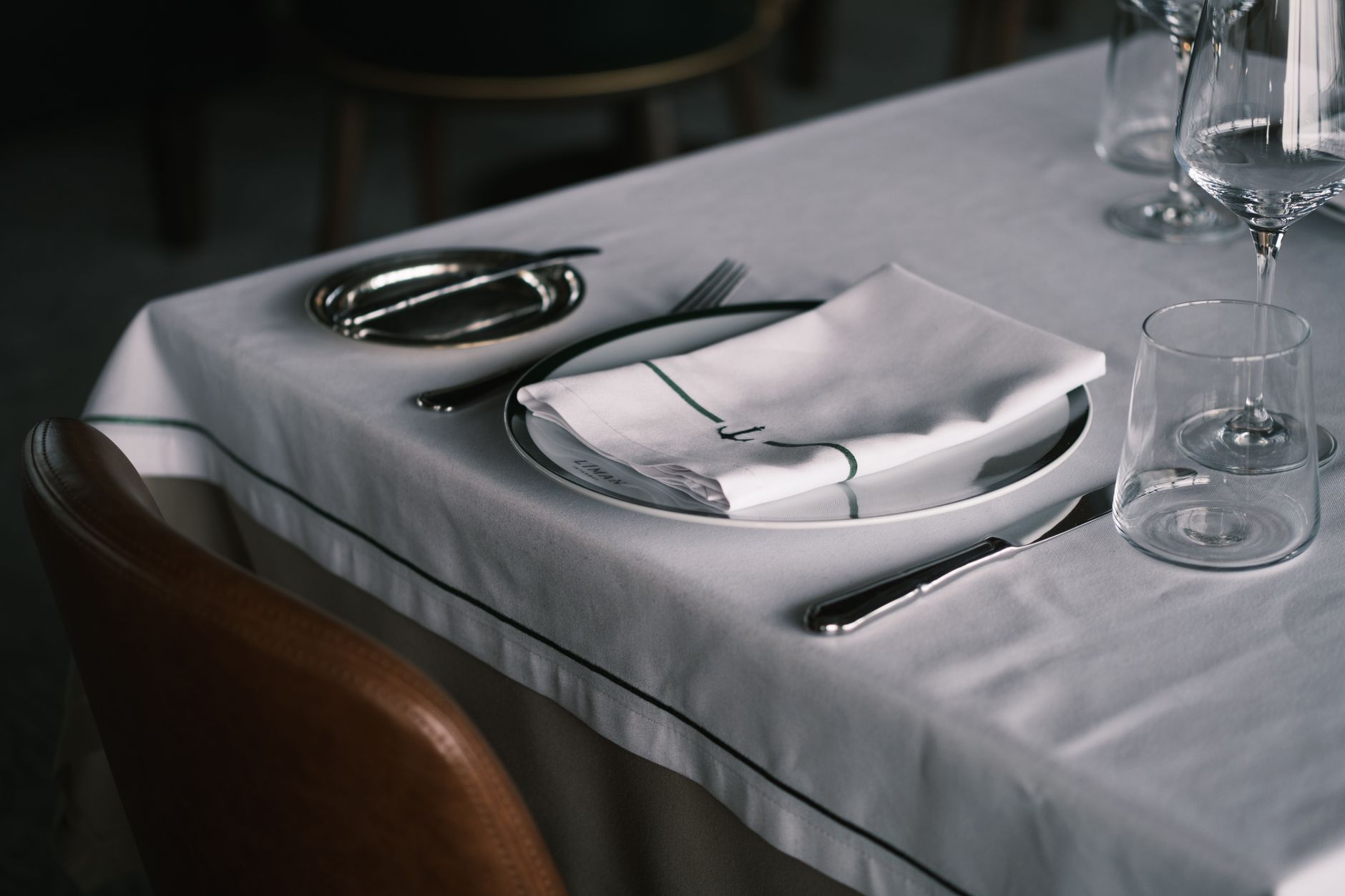
The physical environment of a fine dining restaurant is itself a form of communication. High ceilings, abundant space between tables, heavy linens, low ambient noise — these are signals of luxury, but they're also functional. Space between tables means conversations stay private. Good acoustics mean you don't have to raise your voice. Heavy silverware has a satisfying weight that affects how a dish feels before you taste it. Even the way a napkin is folded and placed signals that someone, before service began, attended to that specific detail.
Dress codes, where they survive, are an extension of this logic. They signal that the dining room has a certain register and that guests are expected to meet it. Many fine dining restaurants have relaxed their codes substantially over the past two decades, but the underlying expectation — that you're arriving as a participant in something deliberate, not just stopping by — tends to hold.
What First-Time Diners Should Actually Know
A few practical realities help enormously on a first visit. Pacing is controlled by the kitchen, not by you — especially on a tasting menu. Courses will arrive when they're ready, and the kitchen will try to calibrate the pace to your table's speed. If you need more time between courses, any server will adjust. Don't feel rushed.
The array of silverware laid at your place follows a simple rule: work from the outside in. The fork furthest from your plate is for the first course; the one closest is for the main. The same principle applies to glasses. Bread plates are to your left; your drink glasses are to your right. These conventions exist not to test you but to make the table readable at a glance for both guests and servers.
Asking questions is not only acceptable — it's expected. If a server mentions an ingredient you don't recognize, ask. If you have dietary restrictions, communicate them when you book, not at the table. If something about a dish surprises you in a way you didn't enjoy, saying so quietly to your server is information the kitchen genuinely wants.
Fine Dining as a Constructed Experience
What distinguishes fine dining from simply expensive food is the intentionality behind every decision. The mise en place, the brigade, the menu language, the tableside ritual, the sommelier — each of these is a tool in a larger project: creating a meal that is more than the sum of its ingredients. The format has been refined over more than a century to produce a specific kind of experience, one where attention to detail at every level is the point.
That doesn't mean it's the only way to eat well, or even always the most pleasurable. But understanding the logic of fine dining — where its rituals come from and what they're trying to accomplish — transforms it from an opaque performance into a readable text. And a readable text is always more enjoyable than one written in a language you haven't been given the key to.