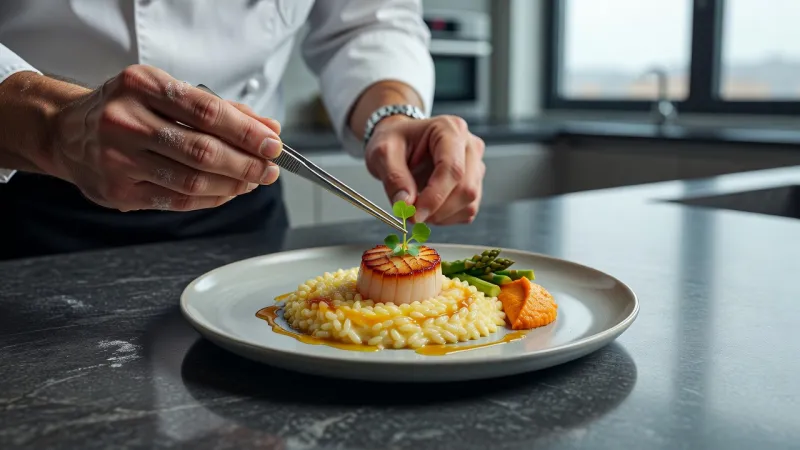
Walk into the kitchen of a traditionally run American restaurant and you'll find a chain of command that would feel familiar to a military officer: orders flowing downward, stations rigidly divided, and a chef de cuisine whose word is absolute law. That structure has a name — the brigade de cuisine — and it has shaped how restaurant kitchens are organized for well over a century. But quietly, and with growing momentum, a new generation of chefs is dismantling it, station by station.
Where the Brigade System Came From
The brigade system wasn't born in a restaurant — it was born in the military imagination of one extraordinarily influential cook. Auguste Escoffier codified the brigade de cuisine system — a military-style hierarchy of station cooks reporting to a chef de cuisine — at the Savoy Hotel in London in the 1890s. Escoffier had served as a cook in the Franco-Prussian War and returned convinced that a kitchen, like an army, needed absolute clarity of rank and responsibility to function at scale.
His insight was genuinely practical for its moment. Grand hotel kitchens in the 1890s were serving hundreds of covers a night with no modern communication technology, no printed tickets flashing on screens, and no way to coordinate except through voice and hierarchy. Dividing the kitchen into specialist stations — saucier, poissonnier, garde manger, pâtissier, and so on — with a clear chain of command meant that a kitchen of thirty or forty cooks could operate with something resembling precision.

As an Amazon Associate, I earn from qualifying purchases.
The model spread rapidly. By the mid-twentieth century it had become the default structure for nearly every serious fine dining kitchen in the Western world, and its language — sous chef, line cook, expediter — embedded itself so deeply into the industry that most people assume it must be the only rational way to run a professional kitchen.
Why the Brigade Became a Problem
The same features that made the brigade system efficient in 1895 began to produce serious costs in a different era. The most obvious is human. A system modeled on military command tends to normalize behavior that would be unacceptable in almost any other professional environment: screaming, humiliation, hazing of junior cooks, and a culture in which suffering — long hours, low pay, verbal abuse — is treated as proof of dedication rather than as dysfunction.
The results show up in retention data. The National Restaurant Association has documented that kitchen turnover rates in the U.S. restaurant industry regularly exceed 70 percent annually, one of the highest of any sector. That figure represents an enormous amount of institutional knowledge walking out the door every year, along with the real costs of constant hiring, onboarding, and training. When a brigade kitchen loses a skilled saucier mid-service, it doesn't just lose a worker — it loses the custodian of dozens of recipes, techniques, and relationships with purveyors.
There's also a creative cost that's harder to quantify but that working chefs describe vividly. In a strict hierarchy, ideas flow in one direction: downward. A line cook who has spent months mastering a particular station might have a genuine insight about how a dish could improve, but the brigade model offers no mechanism — and sometimes no cultural permission — for that insight to travel upward. In a system designed for execution rather than collaboration, creativity is a structural inconvenience.
What Flat Kitchens Actually Look Like
The alternatives being built by younger chefs aren't uniform, and that's part of the point. Rather than replacing one rigid system with another, the movement toward flatter kitchen structures is characterized by deliberate experimentation.
Cross-Training Instead of Fixed Stations
One of the most common departures from the brigade model is the elimination — or at least the loosening — of fixed station assignments. Instead of a cook who spends every service on the grill and nothing else, kitchens built around cross-training rotate their staff through multiple stations over weeks and months. The practical effect is that more cooks understand more of the menu in depth, which makes the kitchen dramatically more resilient when someone calls in sick or quits. The secondary effect, which proponents argue is just as important, is that cooks develop broader technical vocabularies and begin to understand how individual components interact — which is, at its core, what good cooking requires.
Open Communication Structures
Several chefs who have moved away from traditional hierarchy describe replacing the top-down command model with something closer to a standing meeting culture: pre-service briefings where any member of the kitchen team can raise a concern or propose a modification, post-service debriefs where problems are analyzed without blame assignment, and explicit norms around the idea that useful information should travel in all directions. This sounds simple, but it represents a significant cultural shift in an industry where the default response to a junior cook questioning a senior one has historically been swift and often unkind.
Shared Ownership of Recipes and Menus
Some of the most interesting experiments involve changing who controls the menu itself. In traditional brigade kitchens, the chef de cuisine or executive chef is the sole author of the menu, and line cooks are executors of someone else's vision. A growing number of kitchens — particularly smaller, owner-operated restaurants — are involving the entire kitchen team in menu development. Cooks bring dishes to tasting sessions. Ideas are credited to the people who originate them. This changes the psychological relationship a cook has with the food they're making: it becomes, in a meaningful sense, partly theirs.
Does Flatter Structure Actually Improve the Food?
This is the claim that gets the most skepticism from traditionally trained chefs, and it's worth taking seriously. The argument for hierarchy in a kitchen has always been that consistency and speed — the two things diners most reliably want — require clear authority. If every cook is empowered to improvise, the theory goes, the food becomes unpredictable and quality control collapses.
Chefs who have moved away from the brigade model tend to counter this in two ways. First, they argue that the consistency produced by rigid hierarchy is often a false consistency — a mechanical replication of a dish that may be technically correct but lacks the engaged attention of a cook who genuinely cares about it. Second, they point to the retention argument: a kitchen where cooks stay for two or three years rather than six months will produce more consistent food over time, regardless of structure, simply because the people making the food actually know what they're doing.
There's also a more direct creative argument. Some of the most talked-about cooking happening in American restaurants right now is coming out of kitchens that have explicitly broken from the brigade model — kitchens where the chef's role is closer to editor or curator than to commanding officer, and where the energy in the room feels collaborative rather than anxious. Whether that correlation is causal is genuinely hard to establish, but the chefs making this case are not producing mediocre food.
The Honest Complications
It would be dishonest to present the dismantling of the brigade system as straightforwardly positive without acknowledging the real difficulties involved. Flat structures require a level of communication skill and emotional intelligence that not every kitchen environment can support. They tend to work better in smaller kitchens than in large hotel or banquet operations where the original brigade logic still has genuine efficiency advantages. They can also, if implemented carelessly, create ambiguity about accountability — which, during a busy service, can be as damaging as any other kind of chaos.
Some experienced chefs note that what looks like a flat structure from the outside often has informal hierarchies operating just beneath the surface — that seniority, personality, and technical skill still create pecking orders even when no one has an official title. That's not necessarily a problem, but it suggests that the real goal isn't the elimination of hierarchy so much as the elimination of hierarchy's cruelest features: the abuse, the rigidity, and the suppression of ideas from below.
A System in Transition
The brigade de cuisine was a solution to a specific set of problems in a specific historical moment. Escoffier's genius was real, and the system he designed did what it was meant to do. But the problems facing American restaurant kitchens in the 2020s — catastrophic turnover, a mental health crisis among kitchen workers, intense creative competition, and a generation of cooks who are less willing to accept abuse as the price of a career — are not the problems of a Savoy Hotel dining room in 1895.
The chefs quietly rebuilding their kitchens around different principles aren't rejecting Escoffier's legacy so much as recognizing that good systems, like good recipes, need to evolve. The culinary origins of professional cooking are worth understanding — but they were never meant to be a cage. The kitchens producing the most interesting argument for change are the ones demonstrating, service by service, that treating cooks like skilled collaborators rather than interchangeable stations might be the most practical thing a chef can do.
Sources
Every factual claim in this article was independently verified against the following sources: