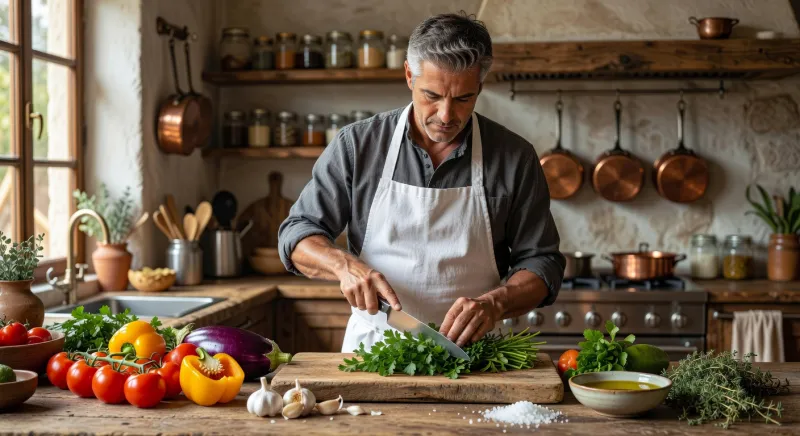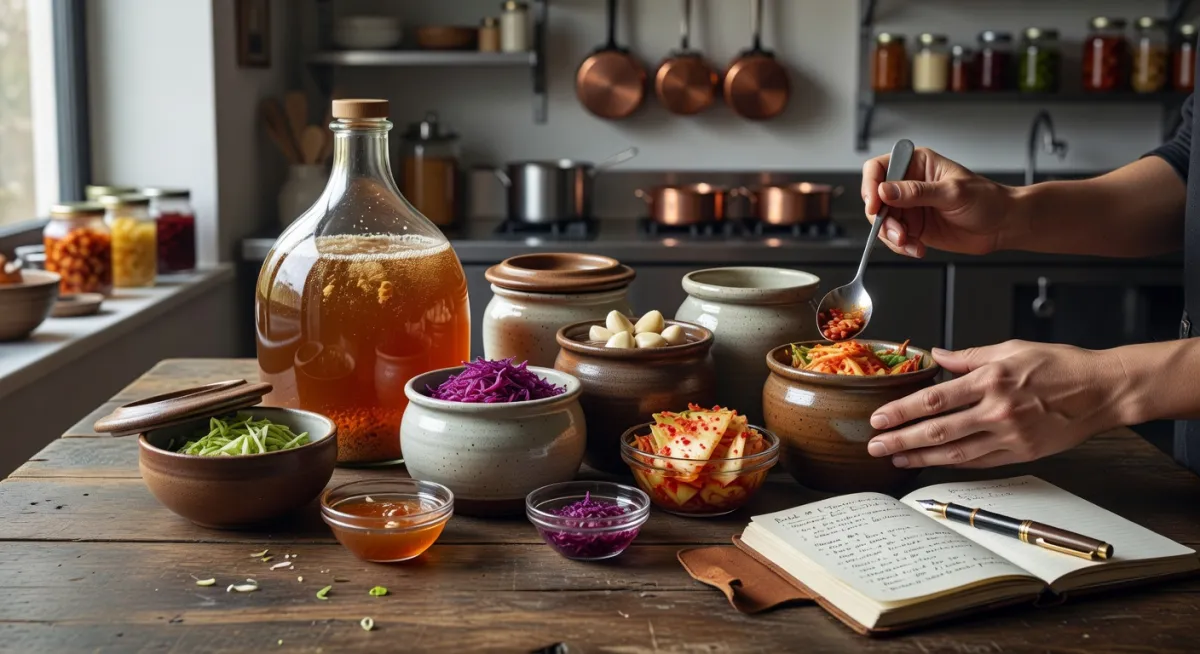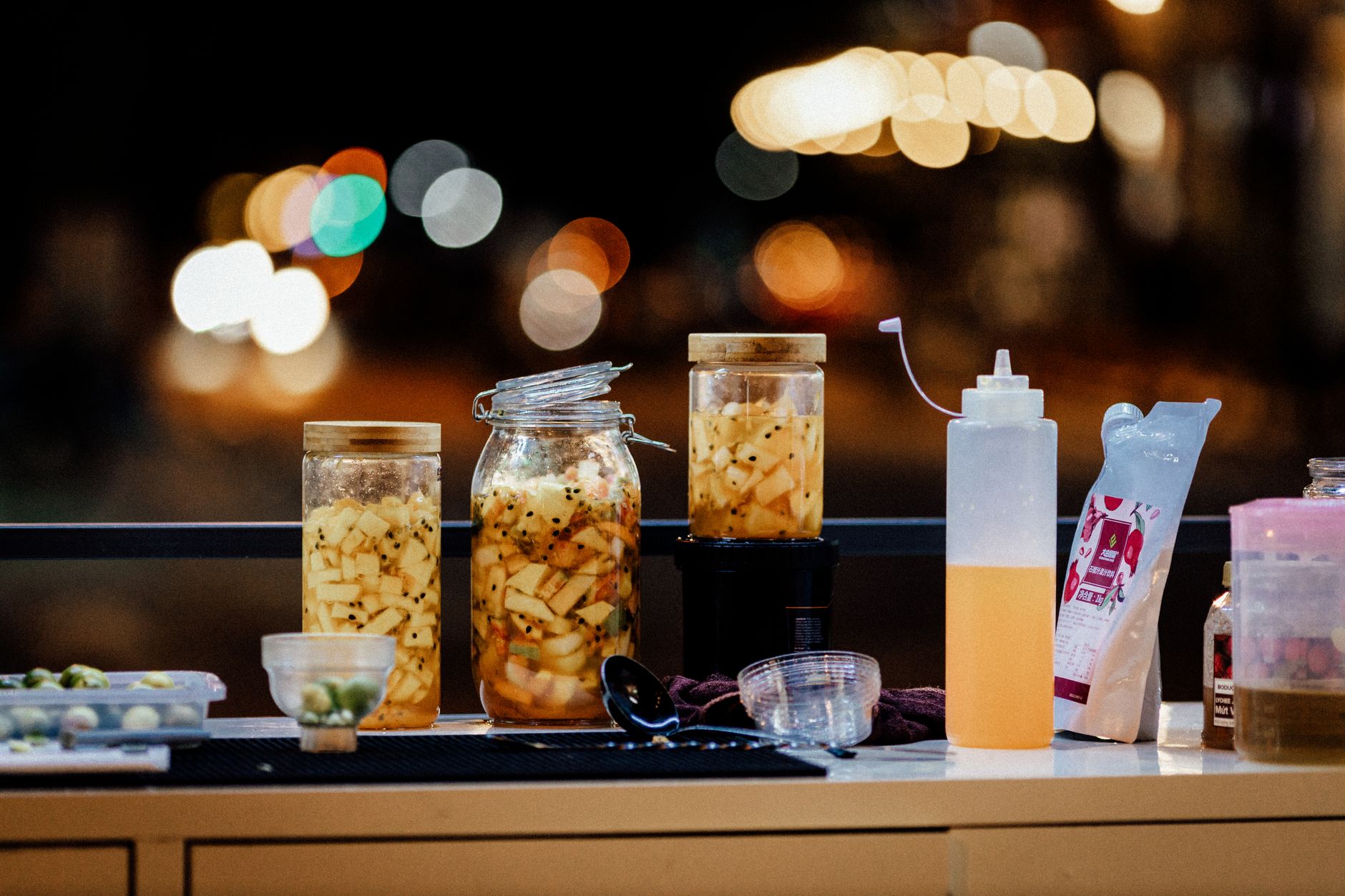
Walk into the right restaurant kitchen today and you'll find something that looks less like a prep station and more like a laboratory crossed with a root cellar. Shelves of ceramic crocks. Jars sealed under airlocks. Tubs of paste that have been sitting in the dark for six months, deepening. Fermentation in American restaurant kitchens has moved from the realm of novelty into something more fundamental — a way of building flavor from the ground up, and a way of telling diners something true about what a kitchen actually believes.
What Fermentation Actually Does to Food
The science is foundational to understanding why chefs care so much. Fermentation is a metabolic process in which microorganisms such as bacteria, yeasts, and molds convert sugars and starches into acids, gases, or alcohols, which both preserves food and generates new flavor compounds including esters and organic acids. Those esters are the same family of molecules responsible for the fruity top notes in wine and aged cheese. The organic acids — lactic acid in kimchi, acetic acid in vinegar — are what give fermented foods their characteristic brightness and depth simultaneously.
In practical kitchen terms, this means fermentation doesn't just change a food's shelf life. It creates entirely new flavors that didn't exist in the raw ingredient. A pile of soybeans becomes miso. Cabbage becomes something that can make a simple bowl of broth taste architectural. You can't replicate this with heat, salt, or acid added after the fact. The transformation has to happen over time, inside the food itself.

As an Amazon Associate, I earn from qualifying purchases.
How the American Restaurant Kitchen Got Here
The story isn't sudden. American chefs have always worked adjacent to fermentation — bread, wine, cheese, vinegar — without necessarily treating it as a distinct craft to be mastered. What changed, roughly in the first decade of this century, was a convergence of influences that made fermentation newly visible and intentional.
The farm-to-table movement pushed kitchens to think about seasonality more rigorously. If you're committed to using what's available locally, you need ways to extend and transform peak harvests. Fermentation is historically the most elegant answer to that problem. At the same time, chefs were increasingly traveling to and drawing from culinary traditions — Korean, Japanese, Scandinavian, Eastern European — where fermentation was never a fringe technique but the backbone of a cuisine's flavor profile.
The publication of serious research and books examining fermentation as craft rather than just process gave chefs a framework to work within. Suddenly there was language, and there was precedent, for building a fermentation program the way you'd build a wine list or a charcuterie operation: with intention, patience, and a guiding philosophy.
House-Made Miso: The Gateway Project
If there's one fermented product that became the unofficial symbol of the serious American fermentation pantry, it's house-made miso. Traditionally a cornerstone of Asian culinary traditions, miso is made by fermenting soybeans — or other legumes and grains — with a mold culture called koji, then aging the paste for months or years. The result is a deeply savory, umami-saturated ingredient that functions as a seasoning, a sauce base, a glaze, and a building block all at once.
As an Amazon Associate, we earn from qualifying purchases.
American chefs began making miso with non-traditional ingredients: chickpeas, corn, sunflower seeds, black-eyed peas. This wasn't cultural appropriation so much as genuine experimentation — asking what the fermentation process reveals when applied to local or unfamiliar substrates. A chickpea miso aged for a year in a Virginia kitchen tastes nothing like a soybean miso from Nagano, but it has its own coherent, complex character. It tells a story about where it was made.
What makes miso a compelling project for a restaurant kitchen is precisely what makes it difficult: time. You cannot rush it. A six-month miso is genuinely different from a three-month miso. This teaches kitchens to plan ahead in ways that shift how a program thinks about inventory, identity, and longevity.
Long-Aged Hot Sauces and the Fermented Condiment Movement
Hot sauce has always had fermentation at its core — Tabasco famously ages its mash in oak barrels — but the craft fermented hot sauce movement in restaurant kitchens takes this much further. Chefs are fermenting chiles whole, blending them at different stages of fermentation, aging finished sauces, and layering fermented chile paste into dishes at multiple points in the cooking process.
The difference between a fresh blended chile sauce and one that has fermented for three to six months is not subtle. Fermentation rounds the sharp, raw heat of fresh chiles while building complexity underneath — a quality that chefs describe variously as depth, funk, or length. It also introduces a natural acidity that doesn't taste added. You can use less of everything else because the sauce is already doing more work.
For fine dining kitchens especially, house-fermented hot sauces have become a signature expression of identity. When a restaurant makes a fermented sauce from chiles grown by a specific farm and ages it for eight months in their own cellar, that sauce is unreplicable. No distributor carries it. No competitor can duplicate it exactly. It becomes part of what the restaurant is.
Koji: The Mold That Changes Everything
Koji — the mold Aspergillus oryzae — deserves its own section because its influence on the American restaurant fermentation movement has been outsized. Koji is the organism responsible for miso, sake, soy sauce, and mirin. What makes it remarkable is the suite of enzymes it produces, which break down proteins and starches into sugars and amino acids with unusual efficiency.
Chefs discovered that applying koji to non-traditional proteins — beef, pork, fish — produces a rapid tenderizing and flavor-deepening effect that mimics long aging. A koji-rubbed steak aged for 48 hours develops qualities that would otherwise require weeks in a dry-aging room. More importantly, it develops its own distinct flavor profile rather than simply approximating traditional dry-age.
Koji also enabled a class of what chefs call "quick misos" — pastes made from meats, vegetables, and koji that ferment in weeks rather than months. Beef miso. Tomato miso. Mushroom miso. These products extend the miso concept into territory that classical Japanese fermentation didn't map, which is exactly the kind of creative translation that defines what American kitchens have contributed to fermentation craft.
Lacto-Fermentation: The Simplest, Most Powerful Tool
Not every restaurant fermentation program involves exotic molds or multi-month commitments. Lacto-fermentation — the process by which naturally occurring bacteria on vegetables convert sugars into lactic acid in a salt brine — is the most accessible entry point, and it produces results that are immediately compelling.
Lacto-fermented vegetables hold their texture while gaining acidity, complexity, and a mild effervescence. Fermented green tomatoes, turnips, garlic scapes, cherry peppers, mustard greens — the range of what can be lacto-fermented is essentially the full produce calendar. For kitchens committed to reducing waste, lacto-fermentation is also a preservation strategy: trim that would otherwise be discarded can become a condiment, a garnish, or a seasoning element with a few weeks in a brine.
What lacto-fermentation offers a dish is brightness without the one-dimensionality of added acid. Because the acidity is produced biologically alongside other flavor compounds, it integrates rather than sits on top. Chefs describe this as "alive" acidity — a quality that's become central to the flavor evolution of modern American cooking.
Vinegar Programs: The Long Game
Making your own vinegar is among the most time-intensive fermentation projects a kitchen can undertake, and it's increasingly common in serious establishments. The process requires first fermenting a sugar source into alcohol via yeast, then converting that alcohol into acetic acid via acetobacter bacteria — a two-stage fermentation that can take months to years depending on the method.
House-made vinegars open possibilities that commercial vinegar simply doesn't offer. A vinegar made from the previous season's apple cider, aged in a barrel that previously held a fortified wine, carries terroir and history in a way that white wine vinegar from a jug cannot. Chefs use these vinegars as finishing elements where a few drops function like a seasoning — lifting, brightening, and completing a dish rather than making it taste "pickled."
The vinegar program also exemplifies what separates fermentation-committed kitchens from those that merely dabble. It requires real infrastructure — vessels, a stable environment, patience across seasons — and it produces a product that takes years to develop a house style. This is fermentation as institutional investment, not trend adoption.
What Fermentation Says About a Restaurant's Identity
The deeper significance of fermentation programs in American restaurants isn't the flavor alone. It's what the commitment to fermentation signals about a kitchen's relationship to time, place, and intention.
A restaurant that maintains an active fermentation program is, by definition, thinking beyond the current week's menu. The miso being made today will flavor dishes a year from now. The hot sauce aging in the back will define the restaurant's palate next summer. This requires a different kind of institutional thinking — and a different kind of kitchen culture — than one organized entirely around daily sourcing and immediate execution.
It also creates genuine distinctiveness. In an era when menus can seem interchangeable across cities and concepts, a fermentation pantry is specific to a place, a team, and a moment in time. The bacteria and molds working in a Brooklyn crock are not the same as those working in a Charleston one. Climate, local microbiota, the particular ingredients available — all of this shapes what a fermented product becomes. No two kitchens will produce identical results, which means the pantry is irreducibly the restaurant's own.
What This Means for the Diner
For the curious eater, understanding fermentation in restaurant kitchens changes how you read a menu and experience a meal. When a dish description mentions house-fermented black garlic, lacto-fermented chile, or aged koji butter, those aren't decorative details. They're telling you that the kitchen has invested months of work into a single component — and that the complexity you're tasting is genuinely irreducible to any shortcut.
It also reframes what a restaurant can be. A living pantry — full of crocks and vessels working quietly in the background — means the restaurant is partly a producer, not just a preparer. It is, in a meaningful sense, farming flavor over time. That changes the relationship between the kitchen and the dish, and it changes what the diner is actually eating when they sit down.
Fermentation has always been with us, hiding in the bread and the wine and the aged cheese. What's new is that American restaurant kitchens are naming it, claiming it, and using it as a primary language for expressing what they know and what they value. That's not a trend. That's a shift in how professional cooking understands itself.
Sources
Every factual claim in this article was independently verified against the following sources:
- Ethanol fermentation — en.wikipedia.org