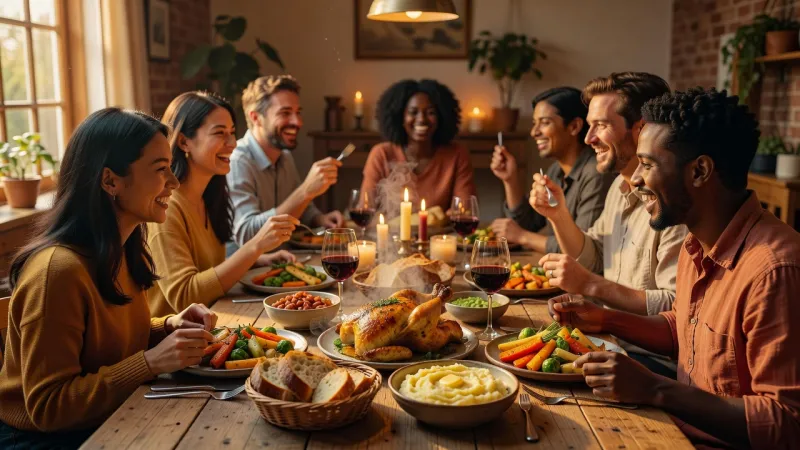
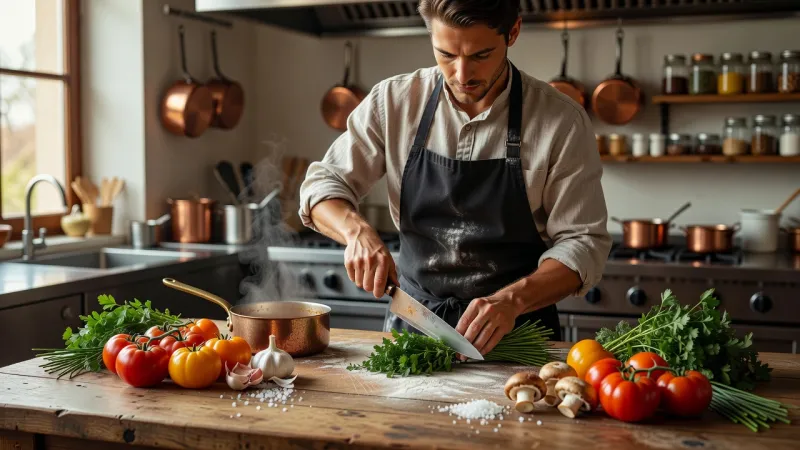
For most of American restaurant history, the kitchen was a secret. Food appeared at your table as if conjured — through a swinging door, carried by someone whose job was to be invisible. What happened back there was considered irrelevant to your experience, or worse, something you were better off not knowing. Then, gradually and then all at once, that wall came down. Today, open kitchens are so common that a fully concealed one in a new restaurant can feel like a deliberate statement. How did that reversal happen, and what did it actually change — not just visually, but in the entire contract between a cook and the person eating their food?
The Hidden Kitchen and Why It Existed
The tradition of hiding the kitchen was not arbitrary. It grew from very practical roots. Early American restaurants — particularly the formal dining establishments that modeled themselves on French service in the nineteenth century — organized themselves around a strict hierarchy of spaces. The dining room was a stage for the guest. The kitchen was an industrial workspace: hot, loud, occasionally chaotic, staffed by workers who occupied a different social class than the diners they served. Keeping them separate was a form of theater maintenance. The illusion of effortless service depended on the effort remaining invisible.
There was also a sanitation argument, real or perceived. Urban reformers in the late nineteenth and early twentieth centuries wrote extensively about the dangers lurking in restaurant kitchens, and public anxiety about food safety made the sealed kitchen feel protective — both for the restaurant's reputation and, supposedly, for the diner's peace of mind. Out of sight, out of worry.
As an Amazon Associate, I earn from qualifying purchases.
This architecture encoded a value system: cooking was labor, not craft. It was something done to food before food became the product. The diner's relationship was with the product, not the process.
The First Cracks: Counter Culture and the Sushi Bar
The open kitchen didn't arrive fully formed. It seeped in through formats where a hidden kitchen simply made no sense. The American diner, with its horseshoe counter and short-order cook working a griddle in plain view, was technically an open kitchen — but it was never theorized as one. It was just efficient. You could watch your eggs being cracked because there was nowhere else to put the griddle.
More philosophically significant was the arrival and rapid spread of the Japanese sushi bar in American cities during the 1970s and 1980s. Here was a format built entirely around the spectacle of skilled preparation. The itamae — the sushi chef — worked directly in front of guests, and that proximity was the point. The knife work, the rice seasoning, the tissue-thin slices of fish: these were not incidental to the meal but constitutive of it. You were not just eating; you were watching someone demonstrate mastery in real time. Asian dining traditions had long understood that preparation and presentation were inseparable, and the sushi bar made that philosophy legible to American diners in a way they could literally sit down at.
The chef's counter — a dedicated seat at or near the kitchen pass where guests could observe cooking up close — was essentially a formalization of what the sushi bar had already proven worked.
As an Amazon Associate, we earn from qualifying purchases.
Alice Waters and the Kitchen as Narrative
Meanwhile, a different kind of revolution was happening in Berkeley. Alice Waters's Chez Panisse, opened in 1971, was among the early influential American restaurants to foreground the kitchen's role in the dining experience, treating ingredient sourcing and cooking as part of the meal's narrative. Waters wasn't designing open kitchens in the architectural sense — Chez Panisse has always had a relatively traditional layout — but she was doing something more conceptually radical: insisting that how food was grown, who grew it, and what happened to it in the kitchen were part of what diners were paying for and thinking about.
This reframing had enormous downstream consequences for restaurant design. If the story of the food included the cooking, then concealing the cooking was suppressing part of the story. Chefs who absorbed Waters's philosophy — and there were many, especially in California — began to think of the kitchen not as a back-of-house operation but as a central argument the restaurant was making about its values.
The 1990s: When Open Kitchens Became Architecture
The explicit design movement toward open kitchens accelerated through the 1990s, driven by converging forces. Restaurant culture was becoming entertainment culture. Food television was beginning its long ascent. The chef, previously anonymous, was becoming a public figure — someone with a face, a voice, a persona. Wolfgang Puck's restaurants had done much to establish this in the 1980s, and as the celebrity chef concept took hold, hiding that celebrity in a back room started to seem like wasted opportunity.
At the same time, urban restaurant design began drawing on industrial aesthetics — exposed ductwork, raw concrete, open shelving. Walls came down generally. In this context, a glass partition or a simple lowered pass between kitchen and dining room felt not just transparent but honest, even democratic. The open kitchen was reading as a statement about the restaurant's confidence in its own process.
Serious fine dining establishments began incorporating chef's tables positioned directly at or inside the kitchen — a format that explicitly offered proximity to the cooking as the premium experience. These seats were often the hardest to book and the most expensive. The kitchen had become the attraction.
What the Design Philosophy Actually Changed
Accountability
The most underappreciated effect of the open kitchen is not aesthetic — it's behavioral. When cooks know they can be seen, the kitchen operates differently. Standards of cleanliness, organization, and composure become visible stakes. A chef who runs a chaotic kitchen in full view of the dining room is making a public statement, and not a flattering one. The open kitchen imposes a form of continuous performance review that the closed kitchen never had. This has, on balance, pushed professional kitchens toward higher standards of organization and cleanliness — not universally, but structurally.
The Diner's Role
Something more subtle also shifted: the diner's psychological position. In the traditional model, you were a passive recipient. Food arrived; you evaluated it. The open kitchen made you a witness to effort. Watching a cook reduce a sauce for twenty minutes, or seeing the concentration on a line cook's face during a dinner rush, changes how you receive the plate when it arrives. You have context. You have observed investment. This tends to generate patience, generosity, and engagement that a closed kitchen cannot produce.
It also creates a new form of social contract. If a diner can see a cook working, the cook can see the diner eating. Eye contact across the pass is possible. Acknowledgment — a nod, a word — can happen. The transaction becomes slightly more human on both sides.
The Chef's Identity
For chefs themselves, the open kitchen resolved a long-standing tension between craft and anonymity. A chef working behind a closed door could produce extraordinary food and receive no direct recognition for it. The open kitchen placed the chef in the dining room's field of perception without requiring them to leave their station. They could remain cooks — doing the actual work — while also being seen doing it. This mattered enormously to a generation of chefs who had trained rigorously and wanted their training to be legible.
Limitations and Honest Tradeoffs
The open kitchen is not without costs. Noise is the most frequently cited: a working kitchen — with its hood fans, clanging sheet pans, and shouted tickets — introduces a sound profile that many diners find fatiguing. Restaurants have become measurably louder over the past three decades, and open kitchen design is a contributing factor. Some operators have installed acoustic panels or soundproofing glass, but these solutions add cost and can undermine the visual openness that was the point.
There is also the question of authenticity versus performance. Once the kitchen is a stage, the temptation to optimize for appearance as well as function is real. Some critics have noted that open kitchens can become theatrical in ways that prioritize the look of professionalism over its substance — a kind of mise en scène that tells diners what they want to see rather than showing them what is actually happening. The distinction between transparency and spectacle is worth keeping in mind.
And not every cuisine translates equally well to the format. Some cooking traditions involve long, unglamorous stages — fermentation, braising, dough resting — that happen hours before service and are simply not visible to any diner regardless of layout. The open kitchen captures a narrow slice of what makes a meal possible.
Where the Chef's Counter Stands Now
The chef's counter — the most intimate version of the open kitchen concept, where a small number of guests sit directly at the pass and interact with the cooks — has in recent years become its own distinct dining category. At its best, it collapses the distance between cooking and eating almost entirely. Courses arrive directly from the hand that made them. Explanation is immediate, personal, and unscripted. The experience resembles a dinner party more than a restaurant transaction.
This format has proliferated particularly in ambitious tasting-menu restaurants, but it has also influenced more casual operations — ramen shops with open broth stations, wood-fired pizza counters, taco bars where the tortillas are pressed in front of you. The underlying idea has migrated far beyond its fine-dining origins: if the cooking is good, showing it is a form of hospitality, not just a design choice.
The wall that once separated kitchen from dining room encoded a specific set of assumptions about labor, class, and the nature of a restaurant experience. Its slow removal has been one of the more quietly consequential shifts in how Americans eat — not because it changed the food, but because it changed who the cook was allowed to be in relation to the person eating it.
Sources
Every factual claim in this article was independently verified against the following sources:
- Alice Waters — en.wikipedia.org