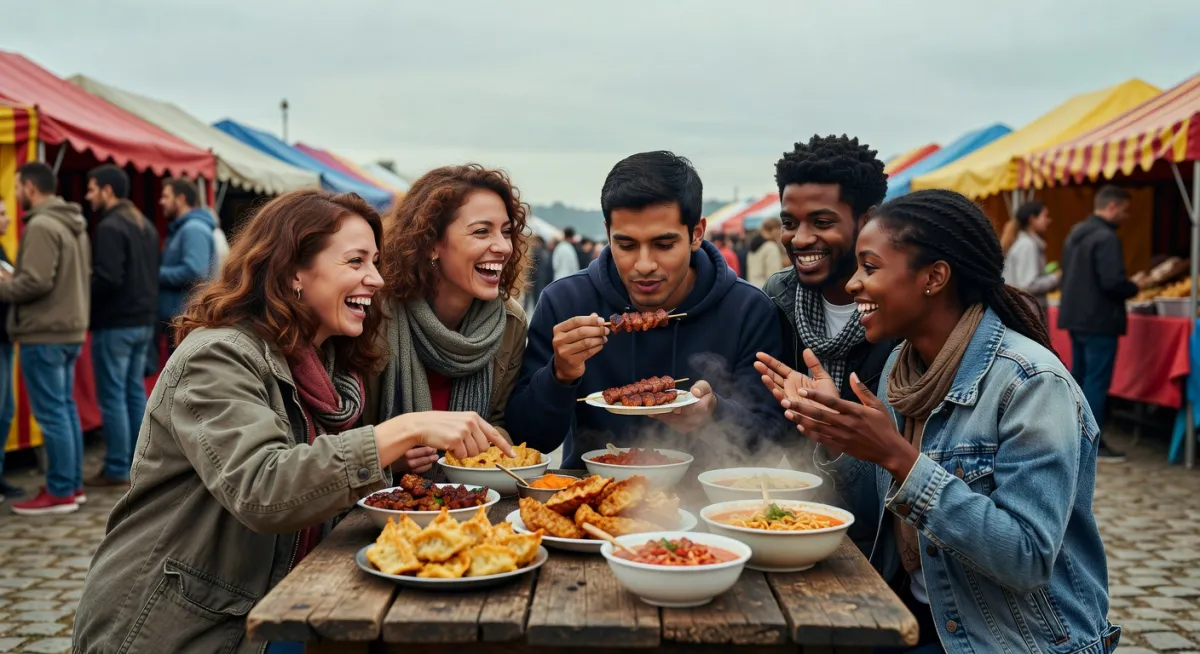
Every summer weekend, somewhere in America, a parking lot fills with folding tables, smoke curls from a pit, and a crowd gathers around something that can't quite be replicated anywhere else. Some of these events are forgettable — generic midway food and corporate sponsorship banners. But the best food festivals in America are something genuinely different: they function as living archives, annual rituals that say this is who we are and where we come from. Understanding what separates those two kinds of events is more interesting than any list of dates and locations.
A Festival Is a Statement About Place
The most enduring American food festivals are rooted in specificity. They celebrate something that could only exist in that particular geography, with those particular people, drawing on a particular history. Maine's lobster bakes, Louisiana's crawfish boils, New Mexico's chile roasting season — these aren't themes chosen by an event-planning committee. They're expressions of how a landscape shaped a cuisine over generations.
When a festival is rooted that deeply, it earns a kind of authority that no amount of marketing can manufacture. Attendees don't just come to eat; they come to participate in something that feels continuous with the past. The food becomes a vehicle for memory and belonging, not just flavor.

As an Amazon Associate, I earn from qualifying purchases.
Compare that to the wave of "foodie festivals" that have proliferated in recent decades — traveling events built around trending ingredients or chef celebrity rather than place. They can be entertaining. They rarely become meaningful.
The Architecture of a Festival That Matters
Community Authorship
The festivals that genuinely matter to communities are almost always built by those communities, not staged for them. That distinction sounds subtle but it determines everything downstream. When local families, civic organizations, and longtime producers are the organizing backbone — rather than outside promoters — the programming reflects actual priorities. Local recipes get demonstrated, not just local names dropped. Elders who carry institutional food knowledge find a place on the schedule. The money, in large part, stays in the region.
The James Beard Foundation, which has long tracked American culinary culture, has consistently recognized that the most significant food traditions in the country are transmitted not through restaurants or cookbooks alone, but through exactly these kinds of communal, recurring events where knowledge passes between people in real time.
Producers at the Center, Not the Periphery
Great food festivals give prominence to the people who grow, catch, raise, or ferment the central ingredient — not just the chefs who transform it. A crab festival that features a waterman explaining how crabbing has changed over fifty years tells you something profound. One that only features restaurant booths tells you very little.
As an Amazon Associate, we earn from qualifying purchases.
This matters practically too. When producers are central participants, the food is almost always fresher, more varied, and more technically interesting than when a festival is purely a retail showcase. You encounter heirloom varieties, regional breeds, and preparation methods that never make it to mainstream menus. Exploring food traditions this way — directly from the source — is one of the genuinely irreplaceable experiences a well-built festival offers.
Depth Over Breadth
Counterintuitively, the festivals most worth attending are often the narrowest in focus. A festival dedicated entirely to one ingredient — bourbon, ramps, hot sauce, peaches — forces organizers and participants to go deeper rather than wider. You discover that what seemed like a single subject contains multitudes: different regional expressions, historical context, production variation, pairing traditions, cultural debate.
Breadth is easy to stage. Depth requires genuine expertise and community. The latter is what makes an event worth traveling for.
What American Food Festivals Preserve
Food knowledge is genuinely fragile. Techniques that are passed down through practice — how to properly smoke a whole hog low and slow over hardwood, how to make a real mole from scratch, how to judge when a sourdough culture is ready — are not reliably transmitted through recipes alone. They require demonstration, proximity, and repetition across years. Festivals create the occasion for that transmission in a way that's harder to engineer otherwise.
The Appalachian food revival of recent years is instructive here. Traditional preparations — leather britches beans, ramp-based pickling, stack cakes built from dried apple filling — were genuinely at risk of being forgotten as younger generations moved away from rural areas. Festivals celebrating these foods have played a measurable role in bringing younger cooks back into contact with older practitioners, creating a living thread rather than a museum exhibit.
Similar stories play out in the Gulf Coast oyster communities, in the Czech and German immigrant food traditions of central Texas, in the tamale traditions of communities across the Southwest. The festival is the annual moment when the knowledge is made visible and practiced publicly, which turns out to be exactly what it needs to survive.
The Tension Between Tradition and Evolution
No honest account of American food festivals ignores the tension between preservation and change. Food cultures are not static — they've never been — and the best festivals reflect that dynamism rather than freezing a single historical moment as definitive.
A crawfish boil in Louisiana today incorporates spice traditions that evolved over decades of Cajun and Creole cross-pollination, Vietnamese immigrant influence in the Gulf Coast shrimping industry, and constant improvisation by backyard cooks. A festival that presents only one strand of that story as "authentic" is being selective in a way that's more political than historical.
The most intellectually honest festivals create space for that complexity. They celebrate a root tradition while acknowledging what it has absorbed and how it continues to change. That honesty tends to make them more interesting to attend, not less — because visitors encounter a living culture rather than a diorama.
Regional Pillars: What Different Parts of America Have Built
The South and the Pit
The American South has arguably the richest festival culture around a single cooking method: barbecue. From the Memphis in May World Championship Barbecue Cooking Contest to countless county-level events across the Carolinas, Texas, and Georgia, these gatherings have preserved and debated regional variations with an intensity that makes them more like living academic conferences than parties. The argument about whether vinegar-based or tomato-based sauce is correct is not frivolous — it's a proxy for deeper questions about regional identity, history, and pride.
New England and the Sea
New England's food festival tradition is anchored in the ocean. Clam chowder competitions, lobster festivals up and down the Maine coast, oyster festivals in Connecticut and Rhode Island — these events are inseparable from the fishing communities that built the region. As those communities face genuine economic pressure, the festivals have taken on additional weight as statements of cultural survival, not just celebration.
The Southwest and Chile Season
Few American food rituals are as sensory or as culturally specific as the Hatch Chile Festival in New Mexico, held each Labor Day weekend in the small farming community of Hatch. The smell of roasting green chiles is, for many New Mexicans, inseparable from the end of summer. The festival draws people who moved away years ago back to a smell and a flavor that carries enormous personal meaning — which is exactly what a great food festival should do.
The Midwest and the Underrated
The Midwest's food festival tradition tends to be underestimated by coastal food media. But events celebrating walleye, wild rice, kolaches, sorghum, and local dairy traditions reflect agricultural and immigrant histories that are as rich and specific as anything on the coasts. They simply haven't been as aggressively marketed.
What It Actually Takes to Build One That Lasts
For anyone thinking about what makes these events work from the inside, a few principles emerge consistently from the festivals that have stood for decades.
Institutional memory matters. Festivals that survive across leadership transitions maintain detailed records of what worked, who participated, and what the founding intent was. Without that continuity, each new organizing committee tends to reinvent from scratch — often drifting toward safer, more generic programming.
The economics have to work for locals, not just visitors. A festival that prices out the community it claims to celebrate has misunderstood its purpose. The best events balance the economic opportunity of tourism with genuine accessibility for residents — the people whose food culture is actually on display.
Conflict is not a sign of failure. The most serious food festivals generate real debate — about who gets to define a regional dish, about whether a particular preparation counts as traditional, about how to handle commercial producers versus home cooks. That friction is a sign of genuine investment. A festival nobody argues about is probably one nobody deeply cares about.
The food has to be actually good. This sounds obvious and is frequently overlooked. All the cultural significance in the world doesn't rescue an event where the food is mediocre. The best festivals treat culinary quality as a form of respect — for the ingredient, for the tradition, and for the people attending.
Why This All Matters Beyond the Weekend
American food culture is often discussed in terms of restaurants, celebrity chefs, and media trends. But the substrate beneath all of that — the actual knowledge, the regional specificity, the community relationships — is largely maintained through events like these. Festivals are where children taste something for the first time that they'll spend the rest of their lives trying to recreate. They're where old arguments get relitigated and new ones start. They're where pride in a place gets expressed through the most direct medium available: feeding each other.
The best food festivals in America aren't just worth attending. They're worth understanding — as documents of how a country that often struggles to know itself has, in specific places and specific moments, figured out exactly who it is.