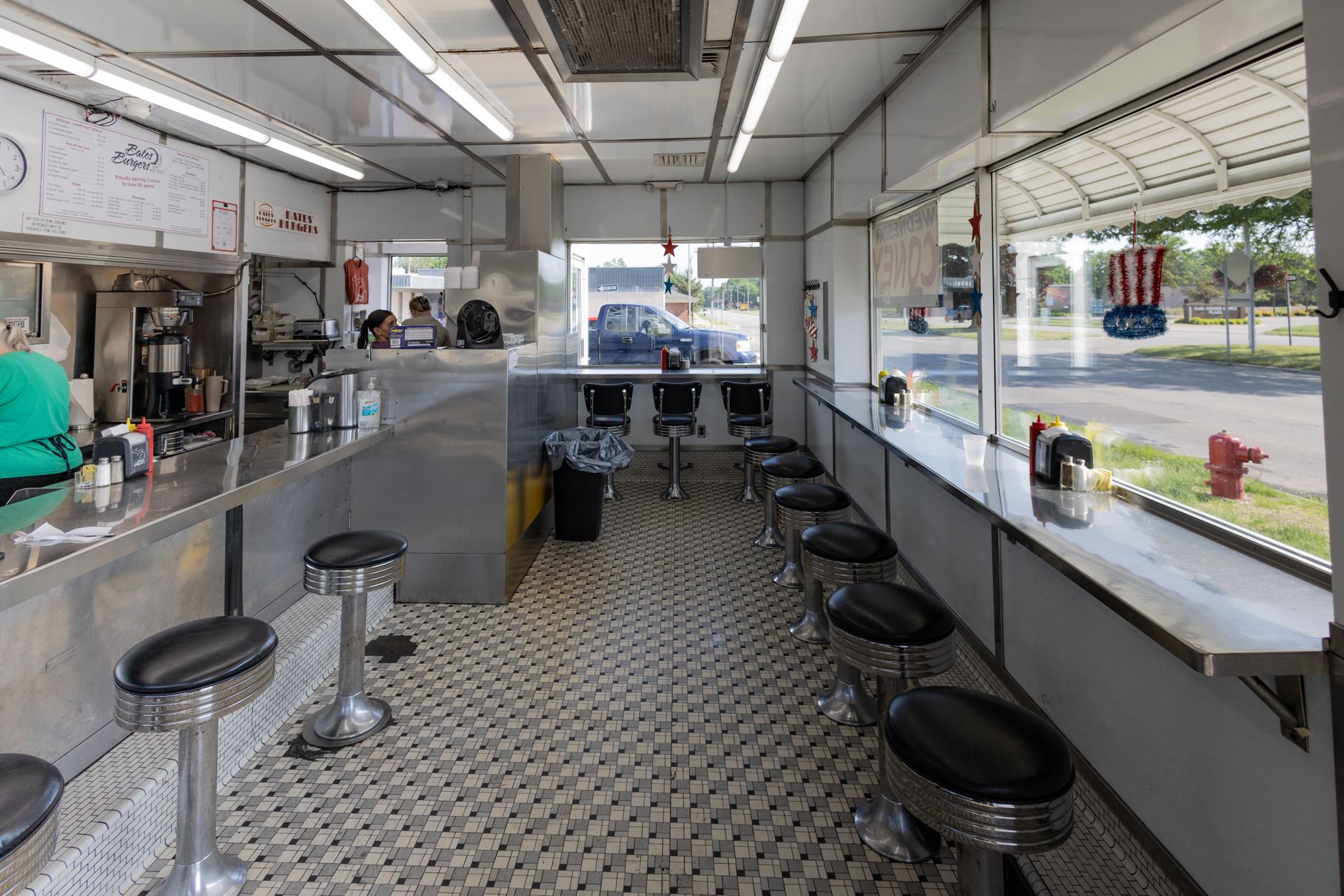
It was just a row of stools bolted to a floor, a laminate countertop, and a short-order cook working a flat-top grill. Nothing about the American lunch counter looked like it was built for history. Yet for nearly a century, this stripped-down dining format did something remarkable: it fed workers, travelers, and shoppers with unusual efficiency, crystallized regional food cultures into repeatable, affordable menus, and eventually became one of the most charged political spaces in twentieth-century America. Understanding American lunch counter history means understanding not just what people ate, but who was allowed to eat it — and how that argument permanently changed the country.
Where the Lunch Counter Came From
The lunch counter's origins are tangled up with the broader industrialization of American life. As cities grew and factories expanded in the latter half of the nineteenth century, workers needed fast, cheap midday meals close to their jobs. Sit-down restaurants were too slow and too expensive for a thirty-minute break. Street food helped, but weather and sanitation made it unreliable. The lunch counter — a long, communal bar where customers sat on stools facing a working kitchen — solved the problem elegantly.
Early versions appeared in railway station dining rooms and urban automats, but the format truly matured inside the five-and-dime store. Chains like Woolworth's, Kresge's, and W.T. Grant figured out that a customer who stopped for a grilled cheese and a cup of coffee was also a customer who might browse the aisles afterward. The lunch counter became a retail anchor, drawing foot traffic and extending the time people spent inside the store. By the 1920s and 1930s, the lunch counter was not just a dining option — it was a fixture of American commercial life, as expected inside a variety store as the cash register itself.
A Democratic Institution — With an Asterisk
Supporters of the lunch counter often called it the most democratic dining institution in America, and there was real truth to that claim. The format obliterated the usual hierarchies of restaurant dining. There was no maître d', no reservation list, no table in the back for the important people and a worse one by the kitchen for everyone else. You found an open stool, you sat down, and you ordered. A shop clerk sat next to a lawyer. A factory worker ate beside a schoolteacher. The food was priced so that almost anyone with a working wage could afford it.
But the asterisk was enormous. In the South — and in many parts of the North — that democracy had a hard racial limit. Black Americans were routinely refused service at lunch counters, forced to stand at takeout windows at the side or back of the building, or simply turned away. The very format that promised equality in its physical design — one counter, one row of stools, one menu — was used to enforce a rigid social hierarchy. That contradiction made the lunch counter an especially pointed target for civil rights activists.
The Sit-Ins and the Counter as Battleground
On February 1, 1960, four Black college students — Ezell Blair Jr., Franklin McCain, Joseph McNeil, and David Richmond — sat down at the Woolworth's lunch counter in Greensboro, North Carolina, ordered coffee, and refused to leave after being denied service. Their action sparked a wave of similar protests across the South.
The strategy was nonviolent and almost deceptively simple. Sit down. Order. Stay seated when refused. Return the next day with more people. Within weeks, the Greensboro sit-ins had inspired similar demonstrations in dozens of cities across the South. The Student Nonviolent Coordinating Committee (SNCC) grew directly out of this movement, and by the end of 1960, lunch counter sit-ins had succeeded in desegregating counters in many cities.
What made the lunch counter such a powerful focal point was its visibility and its ordinariness. This was not an exclusive club or a private institution — it was a retail space where any paying customer was theoretically welcome. The argument was therefore impossible to obscure: the only reason these students were being refused was the color of their skin. The lunch counter's physical design, with its open, public-facing layout, meant that refusals and confrontations happened in plain sight of other shoppers. Television cameras captured it all.
The original Greensboro Woolworth's lunch counter section is now a permanent artifact at the National Museum of American History in Washington, D.C., acquired in 1993. That a countertop made of common materials is now a museum object tells you something important: the lunch counter was never really about the food. It was about access, dignity, and the terms on which Americans would share public space.
Regional Food Identity, Preserved and Distributed
Set aside politics for a moment and look at the lunch counter purely as a culinary institution. Its menus were not nationally standardized in the way that fast-food chains would later become. They were adapted, consciously or not, to regional ingredients, regional tastes, and regional cooking traditions. This is one of the lunch counter's underappreciated contributions to American food culture: it took regional dishes that might otherwise have stayed home and made them into affordable, repeatable, publicly available meals.
In the South, lunch counters served pimento cheese sandwiches, fried chicken, biscuits with sawmill gravy, and sweet tea — not as novelties but as the straightforward default. In New England, clam chowder and fish chowder appeared on counter menus in coastal towns. In the Midwest, hot beef sandwiches smothered in gravy were a lunch-counter staple. Jewish delicatessen counters in New York and Chicago brought pastrami, corned beef, and matzo ball soup into the everyday working lunch. The lunch counter was where these foods became codified — where a cook learned to make a dish fast enough to serve at speed, and where a generation of customers came to expect that dish as a baseline of comfort.
This regional specificity was partly practical. Lunch counter cooks worked with what was available locally and what their regular customers recognized. But it also meant that these menus functioned as a kind of living archive of regional food identity. You could tell something real about where you were in America by what appeared on the lunch counter menu.
The Short-Order Cook as Unsung Figure
Behind every lunch counter was a short-order cook, and this figure deserves more credit than culinary history usually gives them. Short-order cooking is a specific and demanding skill set. The cook works in full view of the customer, managing multiple orders simultaneously on a limited range of equipment — typically a flat-top griddle, a fryer, a broiler, and a soup well. Every motion is visible. Timing is everything. A short-order cook who can't manage the breakfast rush efficiently will drown; one who can becomes a kind of performance, a quiet spectacle of competence that customers find genuinely satisfying to watch.
This transparency between cooking and eating — the cook in plain sight, the food made right in front of you — was a defining feature of the lunch counter experience, and it established an expectation that would echo forward into later dining formats. When you watch a line cook work an open kitchen in a modern restaurant, you are looking at a design philosophy that the lunch counter helped normalize.
How the Lunch Counter Shaped Fast-Casual Design
The lunch counter did not simply fade away when diners, fast-food chains, and food courts arrived. It transformed. Many of its core design principles — counter seating, open kitchens, limited menus executed quickly, no table service — migrated directly into what we now call the fast-casual restaurant.
The fast-casual format, which expanded dramatically from the 1990s onward, returned to the lunch counter's basic promise: better-than-fast-food quality, delivered quickly, in a space that felt unpretentious and accessible. Counter ordering replaced table service. Open kitchen layouts, borrowed directly from the lunch counter's transparency, became a selling point rather than a necessity. Communal or counter seating became fashionable in urban locations.
Even the physical length of many fast-casual ordering lines — customers moving along a counter while their food is assembled in front of them — echoes the lunch counter's logic. You watch the process; you know what you're getting; the speed is built into the architecture. The lunch counter essentially prototyped a dining experience that the restaurant industry would spend decades refining.
What Was Lost
It would be easy to romanticize the lunch counter without accounting for what the format also represented in its limitations. The food, while often excellent, was not always nutritionally balanced — heavy on fat, salt, and refined carbohydrates in ways that reflected both the cooking technology available and the preferences of industrial workers who needed caloric density. The workers staffing lunch counters, predominantly women, were paid poorly and worked in conditions that were physically grueling. The regional variation that made lunch counter menus interesting was also, gradually, eroded as chain management standardized recipes for consistency.
And of course, the democratic ideal always had that hard asterisk. The lunch counter was a site of exclusion before it became a site of contestation, and its desegregation, while real and hard-won, came late and was never perfectly complete. Understanding what the lunch counter genuinely was means holding both the warmth of the memory and the ugliness of what that warmth concealed.
Why It Still Matters
The American lunch counter, at its best, posed a simple question: can we share a meal, side by side, without ceremony, and treat each other with basic dignity? The answer, over the institution's long history, was complicated and inconsistent. But the question itself never stopped being important.
Every time a restaurant designer chooses an open kitchen, every time a regional food becomes the anchor of a fast-casual concept, every time a museum preserves an ordinary object because it carried extraordinary meaning, the lunch counter's shadow falls. It shaped American food culture not by being grand, but by being ubiquitous — by being the place where, for generations, ordinary Americans worked out what it meant to eat together.
Sources
Every factual claim in this article was independently verified against the following sources:
- Woolworth's Lunch Counter - Separate Is Not Equal — americanhistory.si.edu
- Greensboro Lunch Counter | National Museum of American History — americanhistory.si.edu