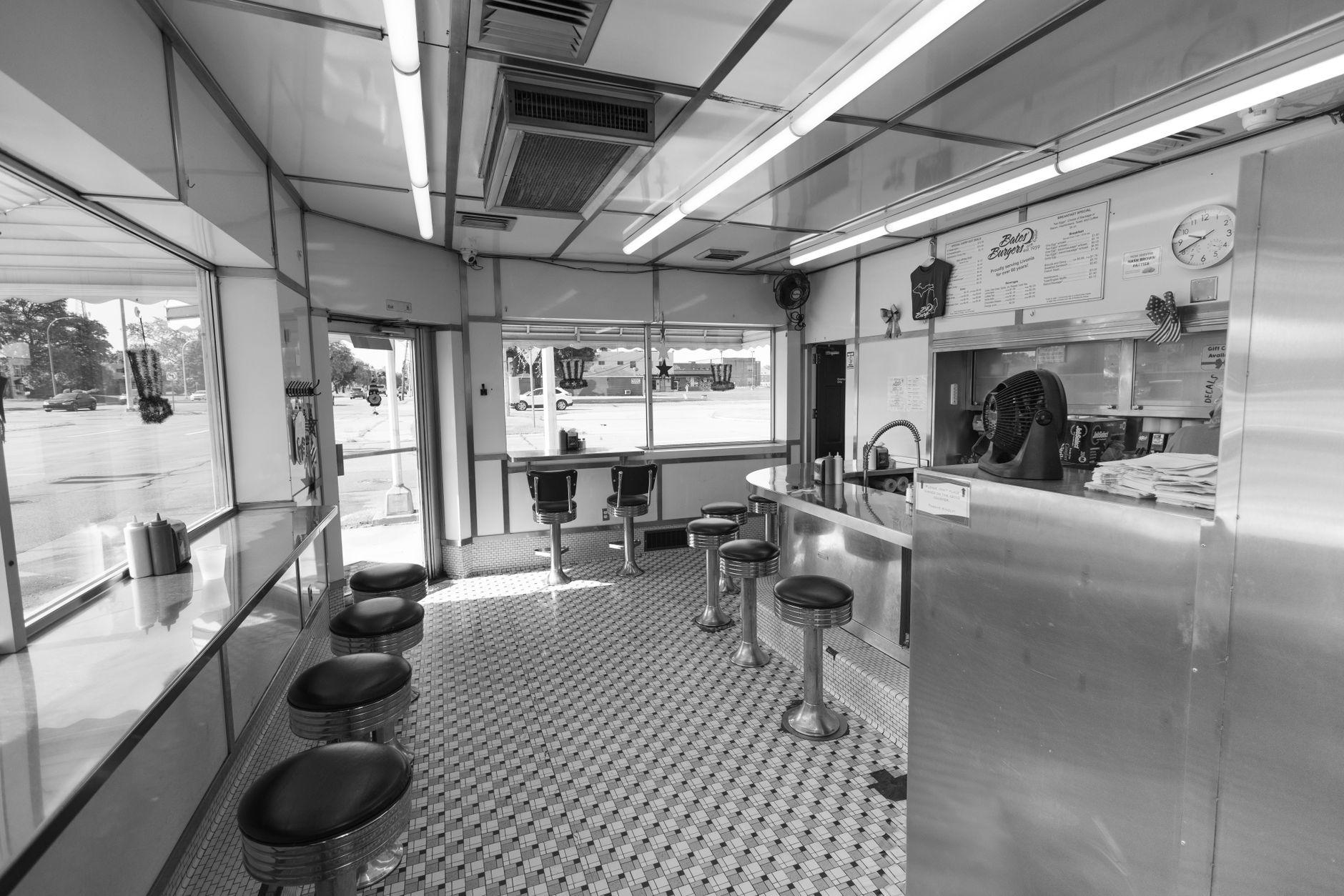
There is something almost mythological about the American diner. You know it the moment you walk in — the smell of bacon grease and coffee, the counter stools worn smooth by decades of elbows, the laminated menu that somehow contains everything you could ever want to eat at any hour of the day. The American diner didn't just serve food. It served as a kind of social contract, a place where a truck driver and a schoolteacher might sit two stools apart and order the same plate of eggs. Understanding American diner history and food culture means understanding something fundamental about how ordinary people in this country have thought about eating, belonging, and what constitutes a satisfying meal.
Where It All Started: The Lunch Wagon Era
The diner's origin story is less glamorous than the chrome-and-neon image suggests. It begins not with a gleaming building but with a horse-drawn wagon. In 1872, a Providence, Rhode Island man named Walter Scott began selling food from a wagon to workers who needed a hot meal after the restaurants had closed for the night. His customers were printers, factory hands, and night-shift workers — people the sit-down dining establishments of the era largely ignored. The idea spread quickly because it solved a real problem: hunger doesn't respect business hours.
These early lunch wagons were utilitarian things, essentially modified freight wagons with a counter and a few stools crammed inside. But they planted a seed. By the late nineteenth century, entrepreneurs were ordering purpose-built wagons from manufacturers, and the business of feeding working-class America on the cheap had become an industry in its own right.
As an Amazon Associate, I earn from qualifying purchases.
The Railroad Car Connection
The leap from wagon to what we now recognize as a diner came partly through the visual language of railroad dining cars. As lunch wagon operators sought to make their businesses more permanent — literally parking them on vacant lots and eventually plumbing them into city infrastructure — they naturally drew on the most sophisticated mobile kitchen most Americans had ever seen: the railroad dining car. The long, narrow footprint, the counter running the length of the space, the kitchen crammed efficiently at one end — all of it echoed rail travel's elegant solution to serving meals in a confined space.
Manufacturers like the Worcester Lunch Car Company in Massachusetts began producing prefabricated dining cars on a factory model, shipping them by rail to operators across the country. These buildings arrived looking like train cars because, in a very real sense, they were built like them. The association stuck even after the design evolved far beyond anything that could actually move on tracks.
The Golden Age: Chrome, Neon, and the Postwar Boom
If the lunch wagon era was the diner's childhood, the decades following World War II were its confident, extroverted adolescence. Returning veterans with money in their pockets, a growing highway system, and a culture drunk on modernity created the perfect conditions for the diner's most iconic incarnation. Manufacturers like Silk City, Kullman, and Fodero competed to produce increasingly spectacular designs — stainless steel exteriors, neon signage, Formica countertops, and terrazzo floors. These weren't apologetic structures. They announced themselves.
The postwar diner planted itself at the intersection of American optimism and American appetite. The interstate highway system, authorized in 1956, meant that a driver in any state might pull off a road and find something that looked, smelled, and tasted reassuringly familiar. The diner became a kind of national vernacular — a shared architectural and culinary language that crossed state lines.
As an Amazon Associate, we earn from qualifying purchases.
The Menu as Democratic Document
What made the diner genuinely democratic wasn't just the price point, though affordability mattered enormously. It was the breadth of the menu. A traditional American diner menu is an act of radical inclusivity on paper. Breakfast all day accommodates the night-shift worker eating dinner at 7 a.m. The blue plate special — a full meal at a fixed, low price — made a hot, complete dinner available to people who couldn't afford à la carte eating. Pie by the slice meant dessert wasn't a luxury reserved for those who could afford to order a whole one.
The physical layout reinforced this. Counter seating meant you sat next to strangers. There was no table in the corner to retreat to, no private booth guaranteed. You were, by design, part of a shared experience. The short-order cook working the flat-top grill was visible to everyone, which created a kind of transparency unusual in restaurants of any era. You could watch your food being made. There was nothing to hide.
Signature Dishes: What the Diner Actually Fed America
The diner's contribution to American food traditions runs deeper than nostalgia would suggest. Several dishes that now feel like permanent fixtures of American eating were refined, popularized, or essentially invented in diner culture.
The All-Day Breakfast
Before the diner normalized it, breakfast was temporal — a morning activity, full stop. The diner's willingness to scramble eggs at midnight or flip pancakes at 3 p.m. was a genuine cultural shift. It acknowledged that human hunger doesn't follow a schedule, and it made breakfast food into comfort food by decoupling it from the clock.
The Club Sandwich
The triple-decker club sandwich — turkey, bacon, lettuce, tomato, and mayo on toasted white bread, cut into triangles and held together with toothpicks — became a diner standard partly because it was filling, visually impressive, and easy to execute on a busy line. It remains one of the most recognizable items in American casual eating.
Pie
Diner pie deserves its own consideration. The glass case rotating near the entrance, displaying several varieties at once, was not just a practical display method — it was theater. Cherry, apple, coconut cream, lemon meringue: the diner pie case made the case that dessert was not a frivolity but a necessary conclusion to a proper meal. Many diners baked their own pies on-site, and the quality varied enormously, but the ritual was consistent everywhere.
The Burger and the Blue Plate
While hamburgers didn't originate in diners, the diner griddled and popularized them for everyday consumption decades before fast food chains industrialized the format. The blue plate special — named for the divided blue plates that kept different food items from touching — made a complete protein-and-sides meal accessible at working-class prices and created a template for what a "real meal" looked like: a main, a starch, a vegetable, bread.
The Diner as Social Space
To think of the diner purely as a food story is to miss half of what it was. For much of the twentieth century, the diner functioned as something between a community center and a confessional. Regular customers had their "usual" — an order so consistent that a good counterperson had it started before the customer sat down. That simple act of recognition, of being known and anticipated, carried enormous social weight for people whose lives might otherwise offer little of it.
The diner also served as a safe space for conversations that required a certain informality. Politicians met constituents over coffee. Deals were made. Relationships ended and began. The low stakes of the environment — you could nurse a cup of coffee indefinitely without social penalty — made it hospitable to long conversations that more formal settings would not accommodate.
It's worth acknowledging, too, that this democratic reputation had its limits. Many diners in the American South were segregated well into the 1960s, and the lunch counter sit-ins of the Civil Rights Movement — most famously at Woolworth's in Greensboro, North Carolina in 1960 — used the diner format as a stage precisely because the denial of service at a lunch counter was such a visible and legible injustice. The sit-ins worked as a protest strategy partly because everyone understood what a lunch counter was supposed to be: open to anyone.
The Decline That Wasn't: Diners and Fast Food
The rise of fast food chains in the 1960s and 1970s posed a genuine threat to the independent diner. Chains like McDonald's and Burger King offered speed, consistency, and prices that undercut even the thriftiest blue plate special. Many diners did close. The roadside landscape changed dramatically as the franchise model conquered American eating.
But the diner did not disappear. It adapted. Some operators leaned into the nostalgia angle, doubling down on vintage aesthetics as the chrome-and-neon look became retro rather than merely old. Others expanded their menus to absorb influences from the communities around them — Greek-American diner operators, who became a major force in the Northeast from the 1970s onward, introduced dishes that sat comfortably alongside the traditional diner menu without disrupting its essential character. A gyro plate next to a patty melt is, in retrospect, exactly what the diner's inclusive spirit always promised.
The casual dining category that emerged in the 1980s and 1990s — chains like Denny's and IHOP — borrowed heavily from the diner template while smoothing out its idiosyncrasies. They offered the familiarity of the diner without the specific personality of any individual one, which satisfied a market but also illustrated what made actual diners irreplaceable: they were particular. They belonged to a place and a set of people.
Regional Variations: The Diner Isn't One Thing
One of the most important things to understand about American diner history is that "the diner" was never a single, uniform institution. Regional variation was always part of its character.
New Jersey and the Northeast
New Jersey has a reasonable claim to being the diner capital of America. The state's density of diners — many of them elaborate, almost palatial establishments with expansive menus running to dozens of pages — represents a particular evolution of the form. The Jersey diner became a destination in its own right, less a quick stop than a place you planned to spend time. Greek-American families who ran many of these operations imported a hospitality culture that reinforced the diner's welcoming character.
The South
Southern diners overlapped with the tradition of the meat-and-three — a restaurant format built around a choice of protein accompanied by three side dishes chosen from a rotating selection of vegetables, starches, and beans. The emphasis on vegetables cooked low and slow, on cornbread over yeast rolls, on sweet tea as the default beverage — these marked Southern diner culture as its own distinct thing, even while sharing the basic democratic ethos.
The Midwest
Midwestern diner culture tended toward a certain stoic plainness. The portions were large, the coffee was always on, and the menu was unapologetically meat-forward. The truck stop diner — a category unto itself — reached its fullest expression in the middle of the country, where long hauls across flat terrain made the warm, brightly lit diner something close to a necessity of life.
What the Diner Tells Us About Comfort
Food scholars and cultural critics have spent considerable energy trying to explain why diner food feels so comforting, and the answers tend to cluster around a few consistent themes. The food is familiar — it uses ingredients and preparations that most Americans encountered in childhood. It is generous — diner portions tend toward abundance rather than restraint. And it is honest — there is no pretension about what it is or what it's trying to be.
This is not accidental. The diner evolved in response to the needs of working people who wanted sustenance and a few minutes of warmth, not an aesthetic experience. The comfort it provided was functional before it was sentimental. That it became sentimental over time is a measure of how deeply it embedded itself in American life.
The concept of comfort food itself — that category of dishes defined less by technique than by emotional effect — is in many ways a diner invention. When Americans describe a dish as comfort food, they almost always mean something that resembles diner food in character if not in precise preparation: something warm, filling, familiar, and unpretentious.
The Diner in the Twenty-First Century
The contemporary American diner exists in a complicated space. Many classic diners have closed as their owners aged and their neighborhoods changed. The economics of independent restaurant operation have become increasingly brutal. But the diner as a concept has never been more influential.
A generation of chefs trained in fine dining technique have opened what might be called elevated diners — restaurants that apply serious culinary skill to the diner's traditional menu while preserving its democratic spirit. The all-day breakfast concept has been adopted by coffee shops and fast-casual operators alike. The counter-service model, the open kitchen, the unfussy welcome — all of it traces back to the lunch wagon on the Providence street corner.
There's also a quiet revival of the original article. Historic diners have been preserved, sometimes relocated and restored, as cultural landmarks. Enthusiast communities document surviving examples with the devotion of architectural historians. The diner has become something people want to protect precisely because it represents something they feel is disappearing: a place with no cover charge, no reservation required, no dress code, and no cuisine to explain. Just food, and a place to sit, and someone who'll fill your cup again without being asked.
Why It Still Matters
The American diner persists in the cultural imagination — in film, in literature, in the shorthand of political campaigns where candidates still make pilgrimages to diners to demonstrate their connection to ordinary voters — because it stands for something that Americans keep returning to as an ideal. The idea that a meal should be available to everyone, that a good cup of coffee and a hot plate of food constitute a basic dignity, that the person next to you at the counter is your neighbor regardless of what they do or where they come from: these are not small ideas.
The diner didn't invent these values. But it built them into a physical space and a daily ritual in a way that made them legible and repeatable. Millions of ordinary meals, served over more than a century, added up to something. That's a harder thing to manufacture than chrome and neon, and it's why no amount of theming or nostalgia can fully replicate an actual diner that has been in business for fifty years. The patina has to be earned.
Whether you're a regular somewhere with a stool you think of as yours, or someone who has only experienced the diner through its cultural echoes, the institution has shaped your understanding of what eating together is supposed to feel like. That's a remarkable achievement for a converted lunch wagon.